Flooring
Flooring decisions in North Texas are materially different from the same decisions almost anywhere else in the country. The DFW climate — high summer humidity, expansive clay soil that causes foundation movement, and wide temperature swings — creates real performance challenges that generic product recommendations don't account for. CMN Construction has installed and refinished flooring throughout the DFW metroplex for over thirteen years, and our material recommendations are calibrated to what actually holds up in this climate.
We work with the full range of residential flooring materials: engineered and solid hardwood (including refinishing of original hardwood found under carpet in established DFW neighborhoods), large-format porcelain and natural stone tile, and rigid-core luxury vinyl plank (LVP) for families who need waterproof performance without sacrificing aesthetics. Every flooring project starts with proper substrate preparation — moisture testing, slab leveling to within 3/16" over 10 feet, and correct acclimation protocols — because every flooring failure we've investigated traces back to skipped prep work.
From a single room to a whole-home flooring replacement, we provide detailed line-item proposals that separate material, labor, and substrate work so you understand exactly what you're paying for. Most flooring projects in our DFW service area are scheduled within two to four weeks of contract signing.
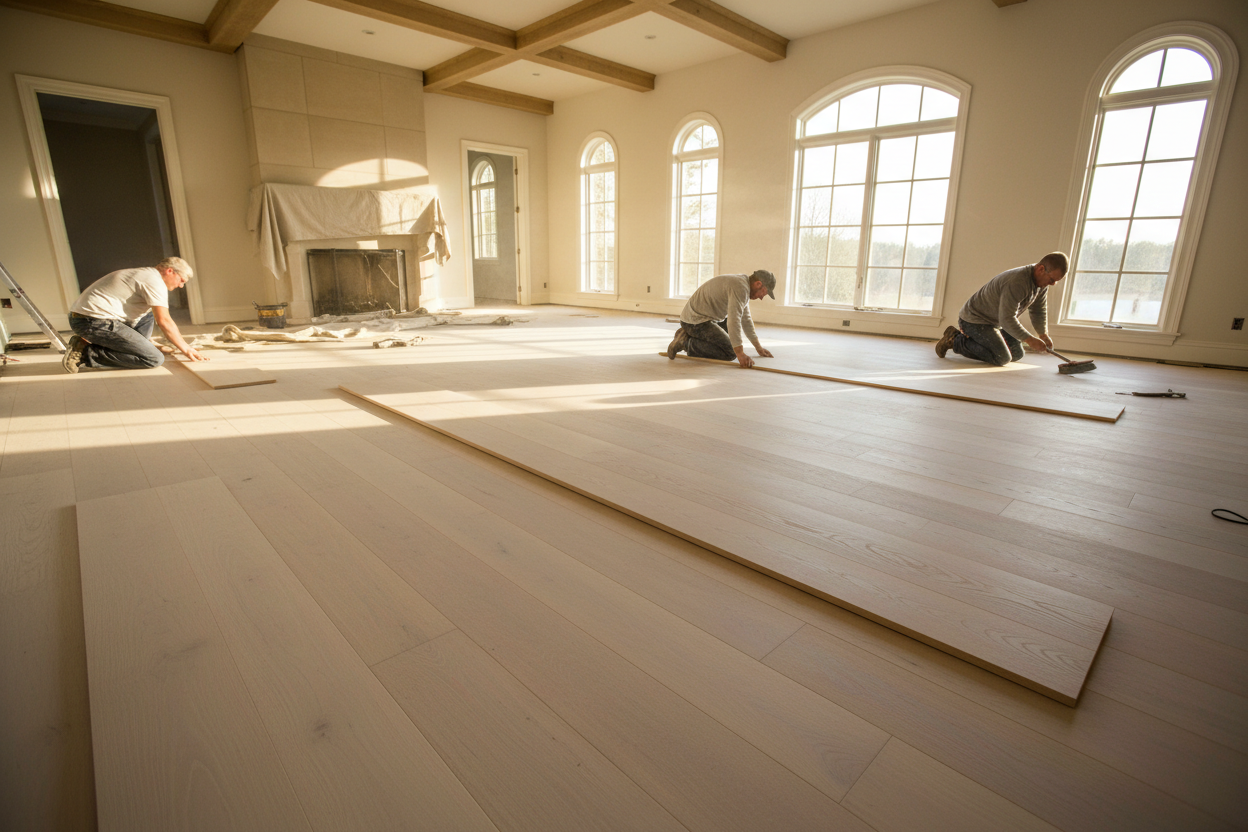
A full scope of work—executed in-house.
- Hardwood installation & refinishing
- Tile & natural stone
- Luxury vinyl plank (LVP)
- Subfloor repair & leveling
- Baseboards & transitions
Our process, simplified.
Flooring decisions in the Plano, Frisco, McKinney, and DFW area are materially different from the same decisions in most other parts of the country. North Texas combines high summer humidity (regularly above 80% relative humidity from June through September), expansive clay soil that causes foundation movement in slab-on-grade homes, and temperature swings that stress materials from both ends. Flooring materials that perform well in the Pacific Northwest or New England can fail prematurely in North Texas without accounting for these conditions.
Flooring in North Texas — why climate and foundation type change everything
Flooring decisions in the Plano, Frisco, McKinney, and DFW area are materially different from the same decisions in most other parts of the country. North Texas combines high summer humidity (regularly above 80% relative humidity from June through September), expansive clay soil that causes foundation movement in slab-on-grade homes, and temperature swings that stress materials from both ends. Flooring materials that perform well in the Pacific Northwest or New England can fail prematurely in North Texas without accounting for these conditions.
At CMN Construction, we've installed and refinished flooring throughout the DFW metroplex for over thirteen years. We know which products perform well in this climate, how to prepare concrete slabs correctly before installation, and what substrate conditions will cause expensive failures later. Our flooring work comes with that knowledge built in — homeowners get material recommendations calibrated to their specific home, foundation, and lifestyle, not to what's on sale at a warehouse showroom.
Hardwood and engineered hardwood — beauty with appropriate expectations
Solid 3/4" hardwood flooring is the premium benchmark in residential flooring, but in North Texas slab-on-grade homes it carries real risk. Solid hardwood is not recommended over concrete because moisture vapor transmission from the slab can cause the wood to cup, crown, or buckle over time. For above-grade applications — second floors, rooms over crawl spaces — solid hardwood remains a beautiful and defensible choice.
For the vast majority of DFW main floors installed over concrete slabs, engineered hardwood is the more appropriate and ultimately more durable choice. Engineered hardwood is real wood — a genuine hardwood veneer over a stable plywood core — with cross-ply construction that dramatically reduces the movement response to humidity fluctuation. Installed with full-spread adhesive over a moisture-tested slab, it delivers the authentic wood grain character and resale value profile of solid hardwood with significantly better long-term performance in the North Texas climate.
Hardwood refinishing is one of the most cost-effective flooring investments available to homeowners with original hardwood hidden under carpet. Richardson, Dallas, Garland, and other established DFW communities frequently have red or white oak hardwood — sometimes parquet — concealed under carpet installed in the 1980s and 1990s. When the floors are in refinishable condition, the result of sanding and refinishing is typically stunning and costs a fraction of new flooring installation.
Luxury vinyl plank (LVP) — where it wins, where it doesn't
Modern rigid-core LVP — specifically SPC (stone polymer composite) products in the 8mm+ thickness range — is waterproof, dimensionally stable, highly scratch-resistant, and visually convincing enough that most visitors can't distinguish it from real hardwood at normal viewing distance. For North Texas families with pets, children, or high-traffic kitchens and mudrooms, LVP's waterproof performance is a genuine and meaningful advantage.
LVP also wins on installation cost and speed — typically 40–60% less expensive than engineered hardwood for comparable square footage. For rental properties, second homes, or rooms where the functional requirements outweigh the premium material considerations, LVP from quality brands like COREtec, Shaw Floorté Pro, or Pergo WetProtect delivers exceptional value.
Where LVP is the wrong choice: high-value properties where buyers expect genuine wood. In the DFW luxury market — homes above $600,000 in West Plano, Legacy West, Frisco, and McKinney — engineered hardwood is the material that justifies the price point. LVP in a $700,000 home can feel like a mismatch that sophisticated buyers notice. We help clients understand this dynamic and make choices that serve their goals, not just their budget.
Substrate preparation — the step that determines whether it all holds
Every flooring failure we've investigated in DFW homes — cupped hardwood, cracked tile, LVP that clicks and moves — traces back to inadequate substrate preparation. The concrete slab must be moisture-tested before any wood or wood-look product is installed. The floor must be flat to within 3/16" over 10 feet (or tighter for large-format tile). Acclimation requirements must be followed. And for hardwood installations, the slab must be at the appropriate moisture content for the specific product being installed.
These steps add time and occasionally cost to a flooring project. They are never optional. CMN Construction does not skip substrate preparation to meet a faster timeline or a lower bid price — because we know that skipping it guarantees problems that come back to us and to the homeowner months or years later. The right flooring installation is a one-time investment; a failed installation is an expensive repeat.
Where we provide flooring.
We deliver flooring across Plano and the surrounding North Texas cities—each with its own landing page and local details.
Request a consultation.

Ready to start your flooring project?
Let's talk through your project. Most consultations start with a 20-minute call.